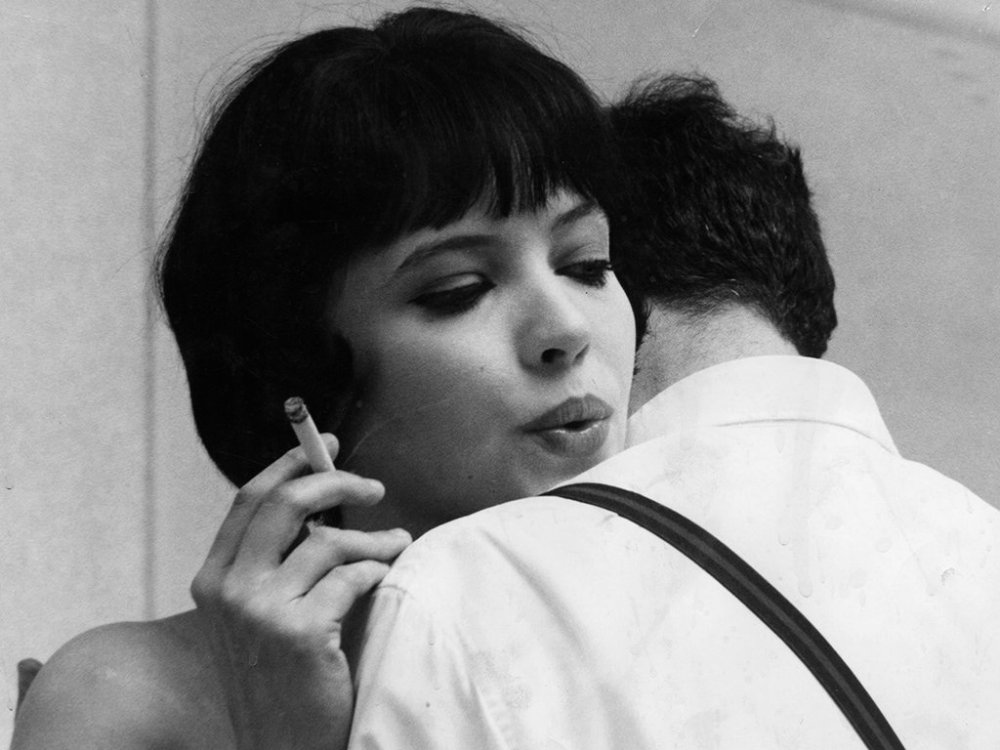
FRENCH NEW WAVE (NOUVELLE VAGUE)

10 great French New Wave films | BFI

FRENCH NEW WAVE (NOUVELLE VAGUE)

  • During WW2 (1939 to 1945) France was occupied by Germany
  • All foreign films were banned, including much loved American genre films.
  • All French films had to be approved by the German censor, leading to a decline in quality from the great French films of the 1920s/30s.
  • Following liberation, nearly a decade’s worth of films poured into France. leading to a boom in film criticism.


CASHIERS DU CINEMA

  • A film periodical formed in 1951
  • Writers included Jean Luc Godard, Francois Truffaut, Eric Rohmer, Claude Chabrol
  • The Cinematheque Francais and the cahiers row.
  • Writers developed the auteur theory- the director as the prime author of the film.
  • They felt that it was through mise en scene that a director could create a personal vision, raiding. B-movie material to a personal film.
  • In 1954 Francois Truffautbwrite an influential essay for Cahiers du Cinema called “A Certain Tendency in French Cinema.”
  • He coined the term cinema du papa- Grandads cinema
  • He felt cinema should reflect the lives of young people.


WHAT FACTORS LED TO THE NEW WAVE?

  • The government introduced subsidies to support the French culture. filmmakers could borrow money and make a movie. only if the film made good money, would they have to pay it back.
  • New light weight cameras, sounds and lights
  • Faster film stocks needed less light
  • Possible to shoot a film away from a studio
  • Camera Stylo- Directors could use the camera like an author used a pen
  • This encouraged experimentation, improvisation- greater artistic freedom.


KEY NEW WAVE FILMS

  • The French New Wave began at the end of the 1950s and ran into the mid-1960s.
  • A Bout de Souffle (Godard, 1959)
  • Le Quatres Cent Coups (Truffaut, 1959)
  • Cleo from 5 to 7 (Varda, 1962)
  • Hirosima Mon Amour (Renais, 1959)

HOW DID LOCATION FILMING AFFECT THE LOOF OF LOOK OF FILMS?

  • Available light was preferred to studio-style lighting and available sound was preferred to extensive studio dubbing.
  • The camera was often very mobile, with a great deal of fluid panning and tracking.
  • Often only one camera was used, in highly inventive ways; following characters down streets, into cafes and bars, or looking over their shoulders to watch life go by.
  • “Camera Stylo”

HOW DID EXISTENTIALISM INFLUENCE THE NEW WAVE?

  • Associated with Jean-Paul Sartre, existentialism stressed the individual, free choice, the absence of any rational understanding of the universe and a sense of the absurdity in human life.
  • An existentialist seeks to act authentically instead of playing pre-ordained roles dictated by society.
  • Characters in French New Wave films are often marginalized, young anti-heroes and loners, with no family ties, who behave spontaneously, often act immorally and are frequently seen as anti-authoritarian.
  • In A Bout de Souffle (1959) the protagonist kills and shows no remorse
  • In Varda’s Cléo de 5 á 7 (1961) the protagonist stops playing the roles others expect of her, when she discovers she has cancer, and starts to live authentically.

HOW WERE ACTORS USED DIFFERENTLY?

  • Associated with Jean-Paul Sartre, existentialism stressed the individual, free choice, the absence of any rational understanding of the universe and a sense of the absurdity in human life.
  • An existentialist seeks to act authentically instead of playing pre-ordained roles dictated by society.
  • Characters in French New Wave films are often marginalized, young anti-heroes and loners, with no family ties, who behave spontaneously, often act immorally and are frequently seen as anti-authoritarian.
  • In A Bout de Souffle (1959) the protagonist kills and shows no remorse
  • In Varda’s Cléo de 5 á 7 (1961) the protagonist stops playing the roles others expect of her, when she discovers she has cancer, and starts to live authentically.

FRENCH NEW WAVE CINEMA WAS A PERSONAL CINEMA

  • The film-makers were writers who were skilful at examining relationships and telling humane stories.
  • Truffaut’s films were particularly autobiographical. His first full-length film Les Quatre Cents Coups drew upon his early life as a juvenile delinquent.
  • New Wave directors used the camera for personal expression, not to satisfy genre conventions.
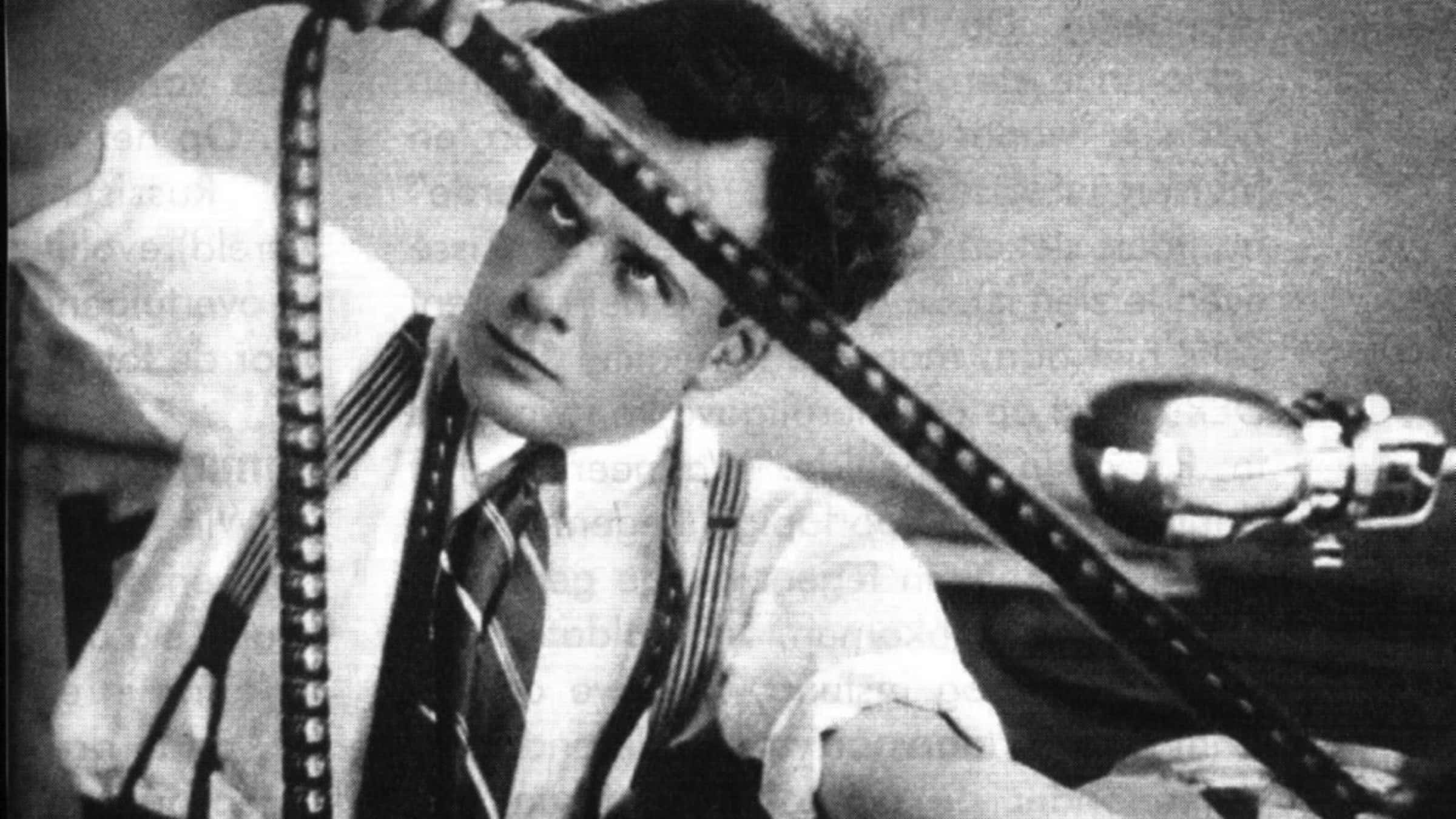
SOVIET MONTAGE

Soviet Montage Theory — Definition, Examples and Types of Montage

WHAT WAS THE HISTORICAL CONTEXT?

  • Russian Revolution in 1917, The Bolsheviks overthrew the Tsar to establish Communism.
  • Needed to consolidate power and communicate their ideas to a huge country.
  • Film a new medium that could communicate to the masses.
  • Films to be used as:
  • Propaganda to explain the ideas of the Communist party
  • Agitate the population to join and support the party
  • Agitation + Propaganda = Agitprop

HOW DID SOVIET FILM THEORY DEVELOP?

  • Founding of the worlds first film school in Moscow.
  • Aim was to train film makers to produce Agitprop films.
  • Lev Kuleshov led workshops sessions where D.W. Griffith’s film “Intolerance” was studied in detail.
  • Lack of available film stock led them to re-edit the film as an experiment, rather than shooting their own material
  • He became interested in montage (editing) as a way of creating meaning.

WHAT IS THE KULESHOV EFFECT?

  • Having experimented with Intolerance, Kuleshov realized that reordering shots could change their meaning.
  • He conducted an experiment, inter cutting shots of an actor with shots of:
  • A hot bowl of soup
  • A child in a coffin
  • An attractive woman
  • Viewers interpreted the actor’s expression as hungry, grief-stricken and aroused respectively, even though it was the same shot each time.

HOW WAS MONATGE USED TO CREATE AGITPROP?

  • Montage was a useful way to communicate meaning:
  • Cinema was silent so films needed to communicate without dialogue.
  • Intertitles were also no good as the population were mostly illiterate.
  • Another film maker, Sergei Eisenstein, used the principles of montage to create films that would persuade viewers to support the Bolsheviks.
  • His film “Battleship Potemkin” contains a famous sequence in which Tsarist soldiers massacre a crowd of unarmed civilians.

WHAT ARE EISENTEINS 5 TYPES OF MONTAGE?

  1. Metric Montage

Cutting according to a regular, specific number of frames, no matter what is happening in the shot.

  1. Rhythmic Montage

Cutting according to the content of the shots. Creates smooth visual continuity between shots.

  1. Tonal Montage

Cutting according to emotional tone of the shots. Shots of a sleeping baby suggest a calm tone, requiring less frequent cuts.

  1. Overtonal Montage 

Considering the use of the previous three kinds of cutting when assembling longer sequences.

  1. Intellectual Montage

Intercutting images unrelated in continuity to suggest ideas and/or concepts.


Creative Geography- Montage could be used to create imaginary spaces that could not exist in real life. In a scene from Just a Gigolo, David Bowie and Marlene Dietrich shot their parts a month apart in different rooms but editing is used to try to create the illusion that they are interacting in the same space.

SURREALISM

Surrealist Cinema and the Avant-Garde – Facets Features

Key Surrealist Films:

  • The first Surrealist film usually considered to be The Seashell and the Clergyman from 1928, directed by Germaine Dulac.
  • Luis Buñuel’s Un Chien Andalou, in collaboration with Salvador Dalí, in 1929.
  • Dalí collaborated with Buñuel again on L’Age D’Or in 1930,
  • Dalí was later hired by Alfred Hitchcock to create a Surrealist dream sequence in Spellbound (1945).
  • Some consider Luis Bunuel to be the only genuiely surrealist film maker.

Contemporary Surrealists:

  • Alejandro Jodorowsky.
  • David Lynch
  • Jan Svankmajer

What Led to the Development of Surrealism?

Surrealism officially began with Dadaist writer André Breton’s 1924 Surrealist manifesto.

  • Influences included:

The strength of Communism/Marxism as a political force. The Russian Revolution had occurred in the previous decade. Sigmund Freud’s ideas about the subconscious, including dream analysis, were also recent and fashionable. Also, the seemingly meaningless slaughter of the First World War which made may artists question what the point of art was in world where such acts were possible. All these factors were an influence on the growth of surrealism.

Freuds Key Ideas: The Three Levels of Consciousness:

  1. the conscious deals with awareness of present perceptions, feelings, thoughts, memories, fantasies at any moment.
  2. the pre-conscious is related to data that can readily be brought to consciousness.
  3. the unconscious refers to data retained but not easily available to the individual’s conscious awareness or scrutiny.

The Unconscious:

  1. a repository for traumatic repressed memories.
  2. the source of anxiety-provoking drives, which are socially or ethically unacceptable to the individual.

Unconscious motivations are available to consciousness in a disguised form. Dreams and slips of the tongue, for instance, are concealed examples of unconscious content not confronted directly.

Key Characteristics:

  • The belief that reality is not orderly and logical but is, in fact, a collection of coincidences and chance occurrences.  
  • The only way to properly express this true reality is by allowing the unconscious mind free expression, rather than being stifled by the rational conscious mind.
  • Surrealist art must not be planned but must grow and develop unconsciously.
  • The first surrealists used automatic writing to access the unconscious part of the brain.
  • The aim was to allow the pen to wander freely, outside of conscious control.
  • This is clearly not possible with film which requires a high level of planning and organization
  • Surrealist films dispense with linear narratives and plots.
  • Traditional cause and effect is rejected, events can seem random and meaningless.
  • This is intended to mimic the random structure of dreams and help the audience access their subconsious.
  • Lack of explanation for the actions of characters draws on Freudian ideas that we are driven by our subconscious and not rationality.
  • Disruption of expectations regarding time. It’s often unclear how much time has passed in surrealist films.
  • Experiments with film language, such as continuity editing. A deliberate breaking of the convention that shots should follow each other in logical sequence. 
  • An attempt to use editing to mimic the random nature of dreams.
  • Mise en scene is used to combine objects in uncanny ways.
  • Surrealist films often use shocking imagery that jolts the viewer.
  • Explicit engagement with taboo subjects such as sexual desire.
  • An attempt to access subconscious desires and force the audience to acknowledge and confront them.
  • Surrealist films often assault traditional institutions in society, such as religion, family, or marriage.
  • Ridiculing of the institutions that constitute the ideological state apparatus.
  • The films are critical of the lifestyles of the Bourgeoisie.
  • Surrealists aimed to make film, a traditional mode of mass entertainment, into one full of revolutionary potential at the social and political level.

The Contradictions in the Surrealists Approach:

  • Surrealists wanted to rediscover a childlike and uninhibited approach to the world but they were also attracted by Freud’s scientific, rationalist research into the unconscious. He felt unconscious thought – often revealed in dreams – dreams could explain human behavior.
  • Surrealists wanted to liberate the creative unconscious but also to develop a plan of political action to overthrow what they saw as the corrupt authority of the church and state. In the 1920s, the surrealists collaborated with the Communist party but also had an affinity with anarchists.
  • The high level of planning required to make a film works against the use of free association, it cannot be “automatic.”

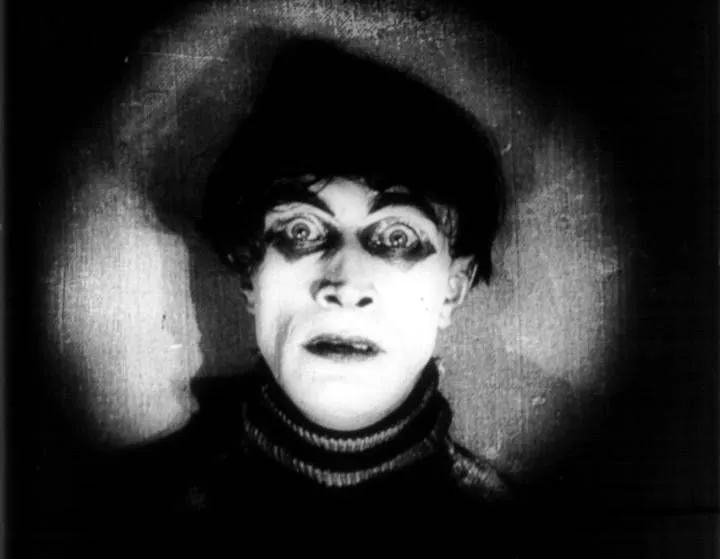
German Expressionism

About German Expressionism - German Expressionism Collection ...Watch: How German Expressionism Influenced Cinema's Dark Side

Expressionism- a manner of drawing, painting or sculpting in which forms derived from nature are distorted or exaggerated and colours are intensified for emotive or expressive purposes.

A film movement that was influential between 1910 and 1930. It was part of a larger expressionist movement in Europe covering: sculpture, architecture, dance and painting. It reached its peak in Berlin in the 1920s

World War 1

1914-1918

  • German government banned all foreign films in 1916, leading to a dramatic increase in German film production.
  • Germany produced 24 films in 1914, 130 films in 1918.
  • WW1 resulted in reduced appetite for romance and action films.

Style: The films and the art of the expressionist period represented the gruesome truth that the people of Germany dealt with. The movies captured the emotions and sufferings of the broken nation and its people.

Key Idea: German Expressionism portrays a subjective, emotional world rather than an objective reality.

Key Themes:  Common themes include insanity, death, fatality and the supernatural. The plots often revolve around murder and the occult.

Stylized Mise en Scene; It rejects realism in favour of extreme distortion used to communicate inner emotional reality. Heavy stylization is symbolic of the real world rather than a realistic depiction of it.

  • Distorted shapes and lines that upset the sense of balance.
  • Suggests a warped and perverted perspective on the world.
  • A reflection of the twisted emotional state of the storyteller.

Lighting: Chiaroscuro lighting creates dramatic contrasts between light and shadow, suggesting presence of dark aspects in human nature. Elongated shadows envelope and haunt the characters. Shadows are also used to reveal characters actions, suggesting their dark intent.

Make Up & Performance: Gothic make up and clothing and exaggerated movements as further distortions of reality, suggesting ill psychological states.

Integrated Aesthetic: Movements carefully choreographed to create specific shapes and shadows. Integrated with mise-en-scene to create an overall graphic composition.

Influence on Subsequent Film Makers:

  • Universal Studios Horror
  • 1930s and 1940s
  • Influence of German directors escaping Nazism, e.g.; Frankenstein
  • Film Noir Genre
  • 1940s and 1950s, e.g. The Big Hear
  • Has influenced movies such as Edward Scissorhands by Tim Burton 1991.

Postmordenism & Hyperreality

Postmodernism- an artistic philosophy which revolves around distrusting theories/ideologies and drawing attention to conventions- a rejection of any notion of objective truth.

It is about 2 things:

  1. Recognising that everything is constructed; nothing is real, we can play with it.
  2. Recognising that we all see the world in different ways- different ways to read a text- polysemy.

Jean- Francois Lyotard defined the postmodernism condition as one- faith in master narratives and claims to a universal truth are lost. The’ postmodernism condition’ is an ‘incredulity towards meta-narratives’- distrust of universal theories of knowledge. The postmodern condition is an “incredulity towards meta-narratives- distrust of universal theories of knowledge.

Jean Baudrillard stated we live in a world in we’re constantly bombarded with signs and information. He wrote the book, Simulacra and Simulation in 1985 to explain key aspects of post-modernism; the blurring boundaries. Mainly with what is real and what is a simulation of reality- simulacra. Baudrillard stated that the border between reality and its representation has collapsed into what he calls ‘simulacrum’. We do not experience the real world but only the world we see in media texts (‘implosion’).  This means that these mediated signs become more real for us than reality itself. Indeed, Simulacrum can be described as a copy without an original. Reality has been replaced by a hyperreality in which we cannot distinguish signs from what they are supposed to represent – we cannot distinguish reality from a simulation of reality.

An example of hyperreality texts are when Christmas adverts on TV or the publicity material for Paris or Disney Land look better than the real thing. A magazine will use Photoshop to manipulate someone’s image (removing blemishes etc.) but still present the photo as ‘real’. For the audience, the image/simulation of the star seems more real because we have never met the star.

Mediation- when media takes something which is real and represents it in a particular way. We understand our reality through the mirror of media. Postmodernists question the representation of history, reality and cultural identities – they seek to challenge who/what is represented, by whom, from what ideological point of view.

Reflexivity & Self- consciousness- the media text is aware of the fact that it is a text. Therefore, a lot of postmodern texts play with their own status as constructed texts. They play with their own conventions, boarders and realities and reference itself and its characters.

Fragmentation and discontinuity- when texts are constructed, their boundaries and structures can be broken up and redistributed. Storylines and characterisations are broken up, disturbed and don’t follow the usual pattern.

Pastiche- a copy of something which is intended to be a tribute to the original text.

Parody- a copy or thinly version of something that makes fun of the original.

Irony- When a piece of art or literature is self- consciously doing the opposite of what it appears to be doing.

Kitsch-produced in mass- usually tacky, sentimental and cheap.

Bricolage- When smaller fragments are stitched together to make a larger whole. It’s a collection of images and ideas; to make a new piece of art or literature.

Do’s and Don’t’s for a University/ Jobs Interview

DO’S:

  • Firstly, it is always important to plan ahead of time for a job interview. Ensure beforehand you know where to go and who to ask for.
  • Prepare before the interview- ensure you know exactly what you’re going to say. For example, your experience, how you suit the role/course.
  • Engage with the interviewer and ask them questions too to also show your interest.
  • Come in with a positive attitude and maintain it throughout the interview.
  • Wear the appropriate attire- make sure you look presentable.
  • Use specific examples in your responses and expand your answers as much as you can.
  • Ensure you remember everything mentioned in your personal statement.

DON’T’S:

  • Not being prepared- showing up not knowing what to say or how to answer questions.
  • Showing doubts about the course/job- not being completely certain you want to go/ be employed in that specific job/course.
  • Being dishonest- lying about past experience.
  • Only relying on your achievements.
  • Being arrogant- showing up being a bit too boastful/ with an attitude.
  • Not making eye contact- it is important to engage with the interviewer as this shows your interest for the job/course
  • Dressing inappropriately- wearing lazy attire such as tracksuits and other causal wear as this shows that you are not taking the interview seriously.
  • Showing boredom throughout the interview- once again this shows lack of enthusiasm and shows you would not be a good candidate.
  • Turning up to the interview late.

Evidence of Undertaking an Interview:

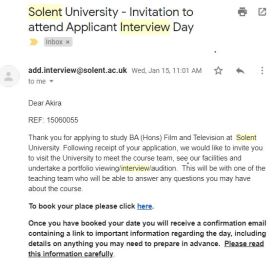
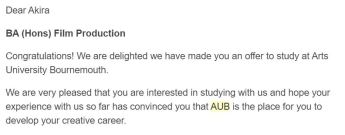
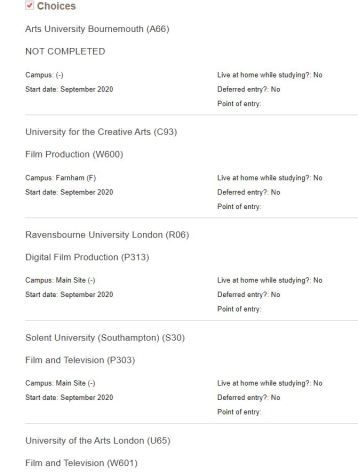
During the process of applying to university I was invited to 2 interviews that I attended. I ensure that I went through the do’s and don’ts of an interview to make sure I was prepared. The universities also sent a rough outline of the questions they would ask; I went through them the night before so that I would be fully ready.

SOLENT UNIVERSITY:

SOLENT solent int

ARTS UNIVERSITY BOURNEMOUTH

aub aub2

I received offers from both of universities after attending the interviews.

PORTFOLIO by AKIRA SHAMBROOK


MY SHOWREEL


LINKS TO MY FULL PROJECTS 

READ ALL ABOUT IT- HORROR OPENING:

A horror opening based on a teenage girl thinking all her secrets are kept to herself, are they really?

CONSPIRACY- SHORT FILM:

A short film in which a student is uncertain of her reality and the world around her.

REEL TALK- SHORT FILM:

Within this production, my peers and I created a live television show in which we reviewed the newest movies/ TV shows out and spoke about the current status of television.

IMPERIUM- SHORT FILM:

This was the final project of the year. This short film revolves around a witch living in a dystopian universe, struggling to control her powers.

LIKE- FACTUAL PROGRAMME:

A documentary my peers and I created on the joys and troubles on social media in today’s society.


PROGRESSION MAGAZINE ON THE MEDIA INDUSTRY:

This slideshow requires JavaScript.

Music Video: Treatment- Not Fair- The Streets of London

Music Video Treatment- Not Fair- Lily Allen

For our project, we aim to create a music video to the song, ‘Not Fair’ originally sung by Lily Allen, covered by The Streets of London. As the lyrics to the song are quite self-explanatory, we want to include a mixture of performance and concept, but use metaphors that match almost directly with the songs meaning, but with a more creative twist.

As the whole song revolves around her boyfriend being perfect apart from the fact that he can’t pleasure her in bed, we aim to include subtle metaphorical visuals that would somehow match what she is singing about, without being vulgar. For example, using certain fruits to symbolise parts of the human body such as bananas and grapefruits. However, we aim to use many other props as well such as balloons, milk, lollipops, etc- overall having fun with how we portray these visuals.

In regards to the performance aspects, we are going to focus mainly on the set design by using pinks and purples for lighting as we still want this to mainly revolve around the idea of love. All of this is aimed to be produced in the studio at college- this way more special effects/ visuals can be created. In terms of the band’s appearance, we also want this theme to stay so them wearing outfits that go with the set and lighting will bring this out more.

Marxism in Media- Cheat Sheet

IDEOLOGY-   rules or doctrines which govern the way we behave (norms and values). this is a set of commonly held beliefs and ideals within a given culture. Whilst these ideologies change from various cultures and shift over time, there is usually a media representative/star that embodies these ideologies. The star can embody these behaviours, aesthetics and ideologies. In return, this also influences the audience how to they should behave, how to dress and how to think. For example, through magazines, music videos, films, television shows will all communicate the common ideologies of the culture.

Dominant Ideology– Ideology that is believed by the majority of the population.

Alternative Ideology- different viewpoint- alternative to the dominant ideology.

Capitalism- economic system in which people are driven to produce goods and services for a profit.

Marxism- this is the belief that leads to the oppression of workers. The rich get richer but by exploiting the hard labour of the poor.

KARL MARX:

Image result for karl marxKarl Marx and Friedrich Engels (German immigrants living in Britain) developed Marxism in the early to mid-19th century. For Marxists, Capitalism (through ideology and force) leads to oppression and exploitation of proletariat (majority/working classes- anyone who sells their labour for money) by the bourgeoisie (wealthy ruling class who own the means of production/minority.

Commodities (objects we buy and sell) always represent the exploitation of the workers who produced who have produced the, because the price at which they are sold is always higher than production costs- the difference between the amount it costs to produce something and the price at which it’s sold is the producers profit. According to Marxists terms, this profit is a direct measurement of the degree to which workers labour has been expired.

Marxism calls for proletarian revolution- workers across the world should unite against their employers- the ruling classes, who oppressed them.

Coercive State Apparatus – physically forcing you to accept the status quo- not allowed to be resistant.

Ideological State Apparatus- sending out messages that make you think the current status quo is acceptable- no need to resist.

The media hold lies, deception and misinformation to the working classes to keep them in a state of false consciousness.

False consciousness- preventing them from seeing their true situation and oppression. It is this idea that stops the proletariat from rising up and seizing power from the bourgeoisie.


Antonio Gramsci

Image result for antonio gramsci

Antonio Gramsci was an Italian political theorist who is renowned for his concept of cultural hegemony. His theory stated that the culture industries, including the media can be used as a means of social control to ensure the ruling classes maintain their power. This theory claims that through media, the ideas of the ruling class are seen as the norm; they are universal beliefs that benefit everyone, whilst only really benefiting the ruling class.

Theodor Adorno

Image result for theodor adorno

Adorno was an advocate of the argument that popular media keeps the population passive. It ensures that capitalism continues at the expense of true happiness. Adorno believed that cultural products offer simple and direct pleasures and we crave these unchallenging products because they seem to validate our lives (which are all bland and standardised). We feel alienated by dull, repetitive and undemanding tasks but this is relieved by dull, repetitive and undemanding media texts/practices, like pop music and dancing.

These theories also link to The Hypodermic Syringe Theory, 2 Step Flow Model and the Cultural Effects model.

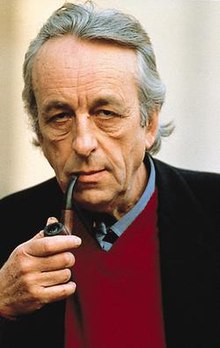
Louis Althusser

Image result for louis althusser

Althusser’s idea of ‘interpellation’ (1970) suggests that the ruling class send out messages in media that support their authority and unequal power relations. When watching these texts, the viewer becomes absorbed into their world view and beliefs (‘interpellation’). The viewer accepts their position in society and they also accept their status – being dominated by the ideas of the ruling class.

As such, our identities and position in society is partly created by the dominant messages we see in media.

For example, in a world in which power is skewed in favour of men (patriarchy), men are the ruling class.  Men then send out messages in media that make women think male dominance is normal and natural. In turn, men oppress women who accept it as they think they have a lower status.